
Forthcoming scholarship · NYU Press · June 15, 2027

A Child from Abroad

The Adoption of Black German Children to Postwar America

Silke Hackenesch

Drawing on German and U.S. archives, Black press reporting, military correspondence and personal testimony, Hackenesch explores the adoption of Black German children by African American families after World War II, connecting family histories with race, citizenship and belonging.

Dr. Rosemarie Peña’s life story opens the volume. This forthcoming book offers connected scholarship for readers exploring the primary sources preserved here.

Book details at NYU Press ↗ · About Silke Hackenesch ↗

Featured photographs & primary sources

Childhood, family & belonging

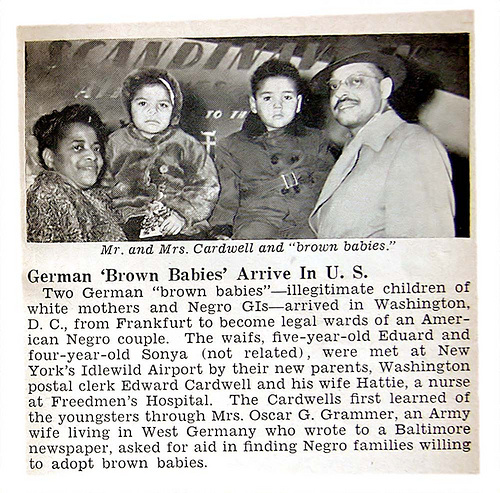
German “Brown Babies” Arrive in U.S. — historical scan

Arriving in the United States

The Cardwell family and two children arriving from Germany. Jet, January 29, 1953.

View the source →
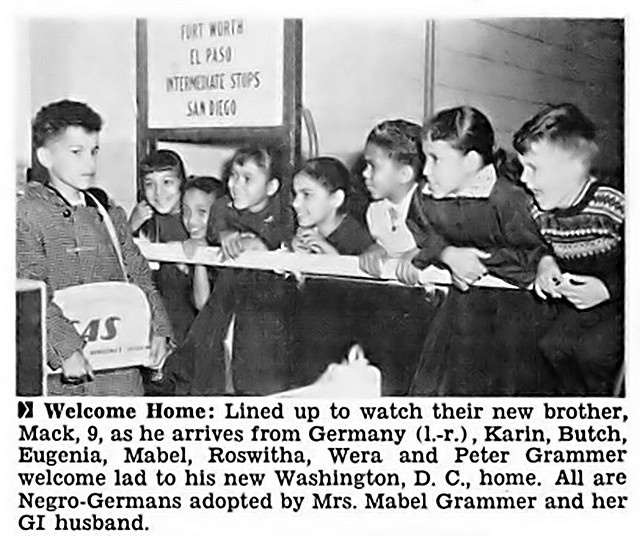
Welcome Home: Siblings arriving from Germany — historical scan

Joining a family

The Grammer family welcomes Mack from Germany. Issue date unverified.

View the source →
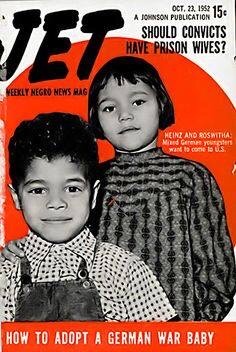
How to Adopt a German War Baby — Jet cover — supplied source scan

Adoption in the Black press

Jet cover, October 23, 1952. Heinz and Roswitha appear on the cover.

View the source →

Search the complete collection. Choose how many records to show per page.

Reading the historical press

Supporting families and portraying adoption

Two Black press reports reveal different ways of responding to the circumstances of Black German children. Read them together to consider whose relationships are visible, who speaks for the children, and what the reporting can establish.

May 7, 1949 · Pittsburgh Courier · Page 2

Children and mothers in Germany

P. L. Prattis describes mothers caring for their children and fathers remaining involved, complicating a picture of universal abandonment. Photographs place mothers beside their children, while an adjacent appeal asks readers to send material assistance.

Support could help sustain existing family relationships. The page does not establish an explicit campaign against separation: it also includes a chaplain’s wish to adopt a child.

P. L. Prattis, “‘Brown Babies’ in Germany,” Pittsburgh Courier, May 7, 1949, p. 2. Digitized under New Pittsburgh Courier.

January 24, 1953 · The Afro-American · Page 1

Arrival in an American adoptive household

James L. Hicks presents two German children’s arrival to meet their adoptive parents as a celebratory story and highlights the newspaper’s role in the arrangements. The photograph and caption foreground their reception and the adoptive mother’s observations.

The German mothers’ accounts and the children’s own interpretations are absent from the supplied page. Arrival coverage alone cannot establish consent, legal completion, or later well-being.

James L. Hicks, “D.C. Couple Adopts First Brown Babies,” The Afro-American, January 24, 1953, p. 1. The article continues on page 2; this comparison addresses page 1.

Assistance and adoption coexisted. These pages do not establish a simple progression from one response to the other, or a single position held by the Black press. Nor can a photograph or an adult’s account tell us what adoption meant across a child’s lifetime. Adoptee testimony and individual records remain essential.

Historical claims and evidence limits

The 1953 headline’s claim to a national “first” is part of the newspaper’s framing. Historian Yara-Colette Lemke Muniz de Faria documents Margaret Ethel Butler welcoming two Black German children in October 1951. Her separately researched account provides historical context; the newspaper’s priority claim should not be repeated as established fact.

See Lemke Muniz de Faria, “Germany’s ‘Brown Babies’ Must Be Helped! Will You?,” Callaloo 26, no. 2 (2003): 342–362, especially 342–343 and 347. Scholarly source ↗.

Original headlines contain historical racial terminology. These terms are retained only to identify and critically contextualize the sources. This comparison reproduces no historical lists of children’s names or family addresses and adds no newspaper images or scan downloads.

Sources shared with BGHRA by Rose-Marie Äikäs, November 3, 2026. Editorial comparison by BGHRA.

Loading collection…