
Surviving page fragments describe adoption procedures, children awaiting placement and stigma against German mothers. They are incomplete; the issue date is not securely established.
Magazine clipping — issue unverified · Undated clipping
Issue date not supplied or not securely established; no date inferred.Magazine clipping — issue unverified. From Dr. Rosemarie Peña’s research files.
Searchable text — uncorrected OCR
OCR may contain mistakes. The scanned original is authoritative.
ARE ALL
.

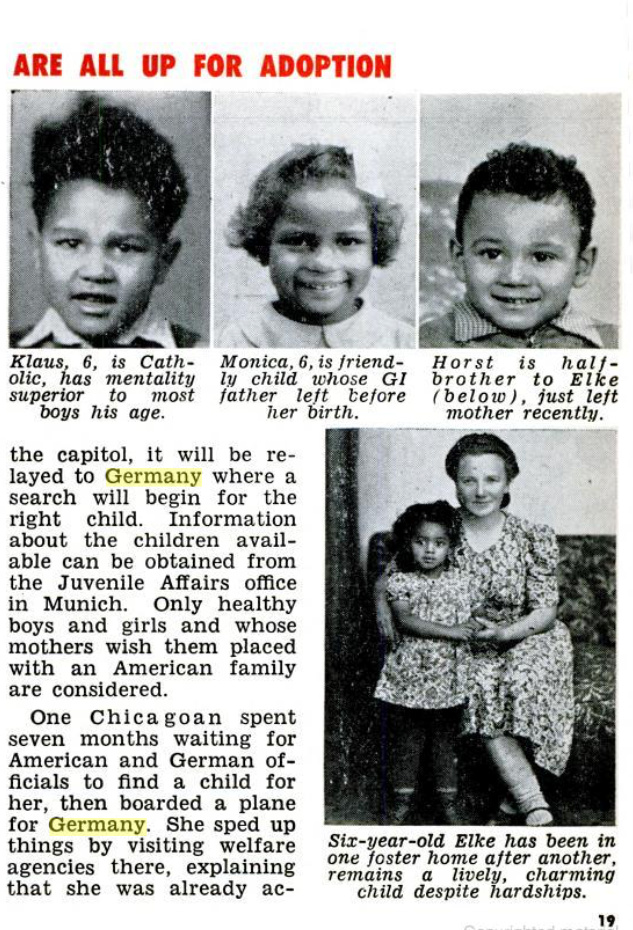
is Cath-

Klaus, 6,
olic, has mentality

superior to most
boys his age.

the capitol, it will be re-
layed to Germany where a
search will begin for the
right child. Information
about the children avail-
able can be obtained from
the Juvenile Affairs office
in Munich. Only healthy
boys and girls and whose
mothers wish them placed
with an American family
are considered.

One Chicagoan spent
seven months waiting for
American and German of-
ficials to find a child for
her, then boarded a plane
for Germany. She sped up
things by visiting welfare
agencies there, explaining
that she was already ac-

Ka
Monica, 6, is jriend-
ly child whose GI
father left before

her birth.

UP FOR ADOPTION

Horst is half-
brother to Elke
(below), just left
mother recently.

Six-year-old Elke has been in
one foster home after another,

remains a lively, charming
child despite hardships.


credited in Chicago and had given the Displaced Per-
sons Commission all the information it requested. With-
in three months, she found the boy she wanted, brought
him home, is now anxiously awaiting the end of the six
months trial period required by Illinois law before his
adoption will be official. Until then, she is his legal
guardian.

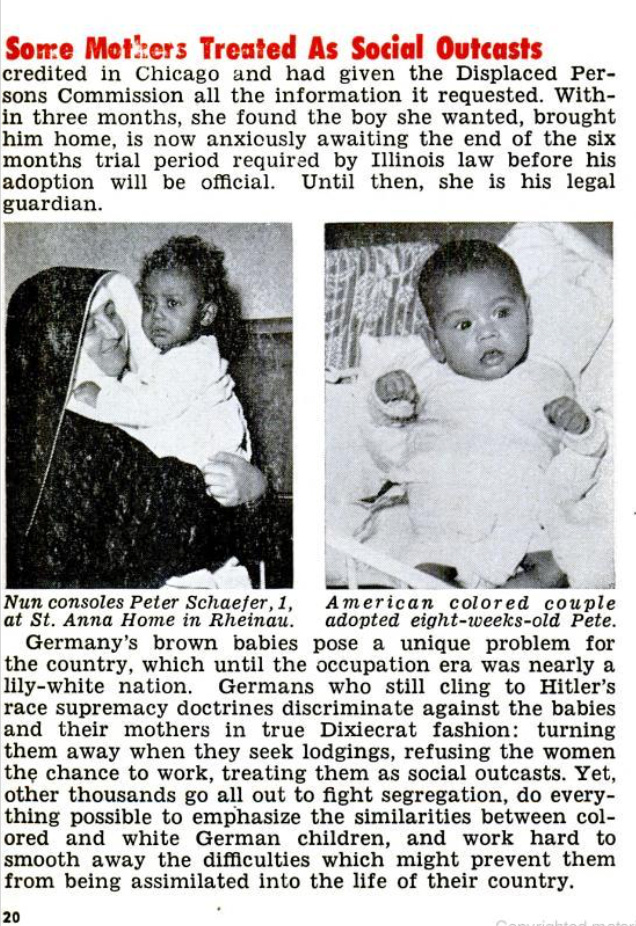
Nun consoles Peter Schaefer,1, American colored couple
at St. Anna Home in Rheinau. adopted eight-weeks-old Pete.

Germany’s brown babies pose a unique problem for
the country, which until the occupation era was nearly a
lily-white nation. Germans who still cling to Hitler’s
race supremacy doctrines discriminate against the babies
and their mothers in true Dixiecrat fashion: turning
them away when they seek lodgings, refusing the women
the chance to work, treating them as social outcasts. Yet,
other thousands go all out to fight segregation, do every-
thing possible to emphasize the similarities between col-
ored and white German children, and work hard to
smooth away the difficulties which might prevent them
from being assimilated into the life of their country.

20
Access image gently brightened and contrast adjusted using conventional image processing; no generative alterations. Original retained separately. OCR is an uncorrected search aid; consult the scan.
Original publication text and photographs retain their respective rights. Historical language is retained as evidence and does not represent BGHRA’s terminology. No open license is asserted.